In 1976 only, Ford offered the “Stallion” appearance group, including styled wheels, blacked-out grille, bumpers, and body moldings, as well as black two-toned accent paint offered with silver, red, white, and yellow body colors. The foray into increased performance emphasis also included a new All-Black Sport Group option for the Mach I and an optional Rallye Package, both adding minor performance enhancements along with the sportier trim.
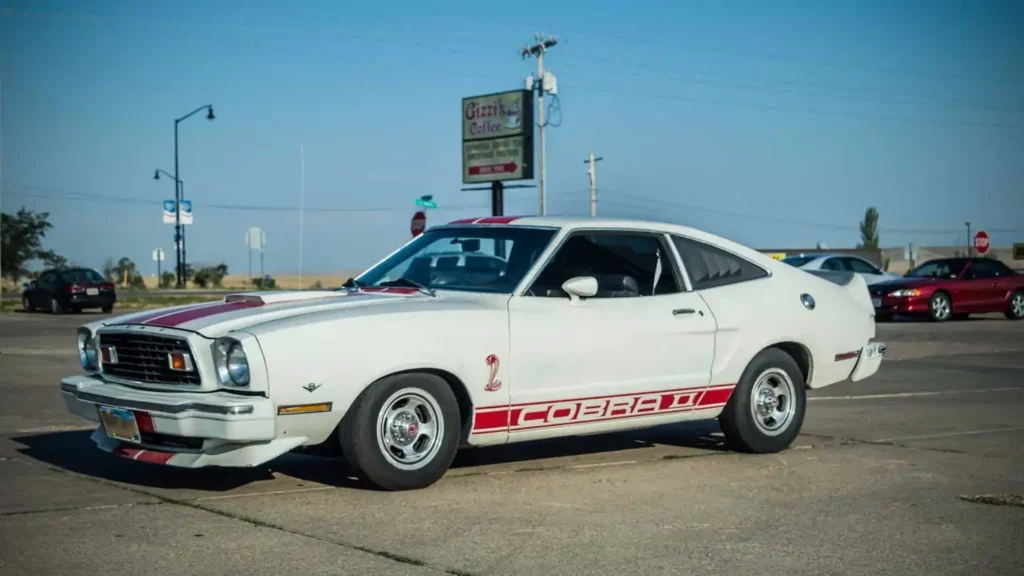
New also was the “Cobra II” appearance package, with a black grille, simulated hood scoop, front and rear spoilers, quarter window louvers, and dual over-the-top racing stripes with matching lower rocker stripes and cobra emblems on the front fenders, echoing the appearance of the original 1965-68 Shelby Mustangs[– available with all engine choices. The Cobra II was popular with the public, with Consumer Guide calling it an “instant success” that likely increased Mustang II’s sales across the board. Automotive historian Gary Witzenburg observed that properly equipped, the thing actually performed pretty well by 1976 standards Full instrumentation was standard.
1977½ Cobra II had revised graphics. Capitalizing on the sales success of the previous year’s racy-looking Cobra II, Mustang II sales literature for 1977 emphasized the more sporty aspects of the car, with the words “Sweet Handling” the featured catchphrase on the cover of that year’s Mustang II dealership brochure (though a luxury Ghia model still got pride of place there). Along these lines, the 1977 model year introduced a “Sports Appearance Group” for the Ghia model that was color-matched to either black or tan paint, as well as several minor styling changes and expanded color options for the Cobra II. Also new was a T-top option for the fastback, featuring twin removable tinted glass panels.
Midway through the 1977 model year, changes for the 1978 model year were pulled ahead to sell early. It is most notable on the Cobra II models, where the hood scoop was turned around to seem more aerodynamic and the graphics were revised. For the decals, the over-the-top dual stripes running the length of the car were replaced with a single stripe, and on the sides of the car, the snake and “COBRA II” decals were replaced with large stripes raised to the middle of the body sides with large “COBRA” lettering in the middle. Louvers were added to the hatch and the side panel louvers only came in black. All of the glass moldings were painted black. With these mid-year changes, for the first time, Mustang II sales brochures featured a sporty 2+2 hatchback model, with its fastback lines, on the cover instead of one of the more formal-looking notchback or Ghia models This new cover model featured the available T-top roof with a bright wrap wrap-over band.
A “chic” Fashion Accessory Package was also offered this year, featuring Southwest-looking, striped “Fresno cloth” seating, enhanced interior lighting, vanity pockets, and special pinstriping. Consumer Guide tested a Mustang II Cobra II that year and found that its power just exceeded that of its closest competitors in the Sporty class, the Chevrolet Monza and its General Motors siblings, but that it ranked very low in handling and ride, with a marked tendency to lean despite its performance suspension.